
An AI evaluator assesses the quality, accuracy, and safety of outputs from large language models and other AI systems to improve model performance through human feedback. These professionals work as independent contractors across multiple platforms, judging responses across dimensions like correctness, helpfulness, harmlessness, and factual accuracy. The work itself is called AI evaluation, the structured assessments evaluators run are known as AI evals, and the role is foundational to modern AI development.
The role emerged as a critical function in training pipelines that use RLHF (Reinforcement Learning from Human Feedback, a machine learning technique where human preference judgments teach models to improve). AI evaluators provide the labeled preference data that teaches models to produce more useful, truthful, and aligned outputs. Professionals pursuing this career path increasingly pursue formal credentialing through Annotation Academy's AI Evaluator Certification, which covers evaluation fundamentals, rubric design, safety fundamentals, and platform-specific workflows across 24 structured modules.
What Does AI Evaluator Mean?
An AI evaluator is a trained professional who judges AI model outputs against quality criteria, providing structured feedback that directly influences how models learn and improve through iterative training cycles.
This definition captures the core function: systematic assessment of model behavior using rubrics (standardized scorecards quantifying response quality). AI evaluators apply consistent standards across thousands of prompts, ensuring training data reflects human preferences and safety requirements. The work combines analytical thinking, subject matter expertise, and attention to detail with technical literacy in prompt engineering and model evaluation frameworks.
What Does an AI Evaluator Do Day to Day?
Stripped of jargon, the job is quality control for artificial intelligence: look at what a model produced, judge whether it is good, and explain the judgment in writing. Nearly all evaluator work falls into three recurring task types.
Comparing responses. A single prompt is answered two or more times by the model, and the evaluator picks which answer is better and explains why. Sometimes the difference is obvious: one answer is simply wrong and the other is right. More often it is subtle, with both answers correct but one explaining the reasoning more clearly or handling an edge case the other ignored.
Rating quality. The evaluator reads a conversation between a user and a model, then scores it against defined criteria such as helpfulness, accuracy, and safety. Was the information correct? Did the response actually address what the person asked, or answer a nearby question instead? These ratings feed directly back into the training process.
Finding problems. Some projects ask evaluators to hunt for failures rather than grade successes: responses that could be harmful, that state something false with confidence, or that are simply useless. This is red teaming, and it exists to surface weaknesses before real users encounter them.
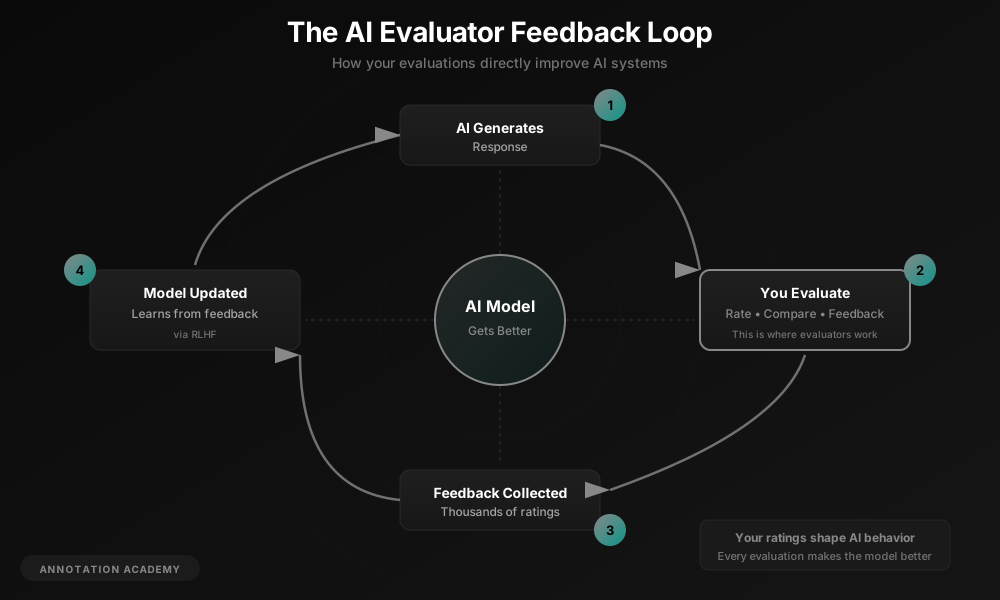
Underneath all three sits the reason the role exists at all: models do not improve on their own. A model can process millions of text examples and still have no way to judge whether a joke is funny, an explanation is clear, or a piece of advice is sound. Human judgment supplies that signal. The technical name for the loop is RLHF, and the human feedback in it is the evaluator's work product: every comparison, every rating, and every written justification is incorporated into training the next version of the model.
When Is AI Evaluator Work Used in Practice?
AI evaluator contributions appear throughout the AI development lifecycle, from initial training through production deployment and continuous refinement.
RLHF and Model Training: Evaluators rank multiple model responses to the same prompt, creating preference pairs that teach models which outputs humans find more helpful or accurate. This comparative judgment forms the foundation of reinforcement learning algorithms. Platforms like Outlier (Scale AI's evaluator-facing brand) and DataAnnotation.tech structure whole projects around these pairwise comparisons, with a single work session covering many prompt-response sets.
Safety and Bias Testing: Specialized evaluators probe models for harmful outputs, testing edge cases where models might produce dangerous instructions, biased reasoning, or manipulative content. This red-teaming work identifies failure modes before public release. Evaluators conducting complex safety assessments require domain expertise in areas like medical misinformation, financial fraud, or violent extremism, the kind of advanced specialization that builds on the safety fundamentals taught in Annotation Academy's AI Evaluator Certification program.
Production Monitoring: Post-deployment evaluators audit live model outputs to catch quality degradation or emerging failure patterns. This ongoing quality assurance catches issues that automated metrics miss, such as subtle factual errors or contextually inappropriate responses that maintain technical coherence while missing user intent.
What Is a Concrete Example of AI Evaluator Work?
Consider a coding assistance model evaluation project on Mercor, which requires AI interview screening for expert-level work.
Example Workflow: An evaluator receives a prompt asking the model to write a Python function for binary search. The model generates three candidate responses. The evaluator ranks these responses from best to worst, then writes a justification of a few hundred words explaining the ranking. Notably, the justification addresses code correctness, efficiency, readability, edge case handling, and documentation quality. The evaluator identifies that Response A implements the algorithm correctly with clear variable names and handles empty arrays, Response B contains an off-by-one error, and Response C works but uses confusing notation.
The evaluator must cite specific line numbers when identifying bugs, reference Python style guidelines when critiquing formatting, and calculate time complexity using Big O notation (a measure of algorithm efficiency). This structured feedback trains the model to prioritize correctness while maintaining professional code standards. This type of preference ranking work requires mastery of rubric interpretation and technical depth, skills taught systematically in Annotation Academy's AI Evaluator Certification curriculum.
Where Do AI Evaluators Work?
AI evaluators operate as independent contractors across specialized platforms that connect them with AI companies running evaluation projects. The market divides into four rough categories:
- Large-scale evaluation platforms that supply RLHF training data to major AI labs
- Specialized annotation companies focused on particular project types
- AI talent marketplaces that match evaluators to individual projects
- Direct hires, where an AI lab or startup staffs evaluation in house rather than through contractors

Outlier (Scale AI) represents the largest evaluation platform. The platform offers the widest variety of project types, from creative writing assessment to technical code evaluation. DataAnnotation.tech focuses on structured data annotation and model testing, with payment schedules set by each platform. Mercor targets senior practitioners with specialized domain knowledge through a proctored interview process. Appen provides additional project access, though work availability fluctuates based on client training cycles.
Compensation for AI evaluator work varies significantly by platform, expertise level, and specialization, and it is set by the platforms rather than by any certifying body. The typical progression starts with straightforward annotation and labeling work; as quality scores and demonstrated consistency accumulate, more complex projects requiring deeper judgment open up, and domain specialists in fields like medicine, law, coding, or finance reach project types that need professional knowledge. Rates reflect the technical depth required: evaluators with background in inter-annotator agreement methodology (statistical measures of rater consistency), complex rubric frameworks, and multimodal annotation (evaluation of text, image, and audio content together) are positioned differently from entry-level contributors. For how the major platforms structure their pay, see the comparison of AI training platforms.
How Can You Become an AI Evaluator?
Becoming an AI evaluator typically requires three steps: building domain expertise, understanding evaluation methodology, and applying to platforms that match your skill level. No formal degree is required, and a computer science background is not a prerequisite for general evaluation work; what platforms screen for is demonstrated judgment and consistency.
Step 1: Build Technical Foundation: Most platforms want subject matter expertise in at least one domain: software engineering, writing, research, mathematics, or specialized fields like law or medicine. This ensures evaluators can judge model accuracy meaningfully. Entry-level contributors often start with writing or general knowledge evaluation; technical domains require deeper preparation.
Step 2: Learn Evaluation Methodology: Systematic training in evaluation frameworks prepares you for the standards platforms apply from your first task. Annotation Academy's AI Evaluator Certification program covers 24 modules spanning core competencies, prompt engineering, response quality assessment, rubric design, RLHF fundamentals, and safety fundamentals. Kappa, the AI study partner, provides personalized guidance throughout, while proctored assessments via ClassMarker ensure credential validity.
Step 3: Apply to Platforms: Start with platforms matching your expertise. General writing experience suits Outlier; a software engineering background fits Mercor's technical projects; research expertise suits DataAnnotation.tech. Most platforms open with a qualification test, then use reference standards (gold-standard evaluations) and ongoing quality checks to screen contributors. Recognizing those standards before you meet them on a live project is the practical value of formal preparation.
Learn more: How to Become an AI Evaluator
Key Skills AI Evaluators Need
Successful evaluators combine technical literacy with systematic judgment and clear written communication.
Rubric Interpretation: Understanding AI evaluation rubrics deeply, not just following checklists, but grasping why each criterion matters to model alignment. This requires reading rubric definitions carefully, asking clarification questions through platform support channels, and practicing on calibration tasks before rating real projects.
Structured Writing: Justifications are not opinions. Each judgment must cite specific evidence from the model's output, reference rubric language, and explain the reasoning chain. Vague reasoning is not usable training signal. A strong justification proves the evaluator applied the rubric consistently and understood nuance.
Domain Expertise: Technical evaluators need current knowledge of their domain. Coding evaluators should understand modern Python, debugging, and performance optimization. Writing evaluators should read widely and understand genre conventions. Medical evaluators must know current clinical guidelines.
Attention to Detail: Fatigue errors, missing subtle factual mistakes deep into a long rating session, directly reduce work quality. Strong evaluators build breaks into work sessions, re-read justifications before submission, and track their own consistency patterns.
Consistency and Reliability: Platforms track accuracy and agreement over time. Ratings that swing unpredictably from task to task are the fastest way to lose access to work, regardless of how defensible any single rating was.
What the Work Is Like
The flexibility is genuine. The work is remote and asynchronous, with no commute, no dress code, and no fixed schedule, which is why it suits students, parents, and anyone who needs to fit paid work around fixed commitments.
The trade-offs are equally real. The work is solitary, the judgment calls can feel repetitive across a long session, and volume is uneven: some weeks bring plenty of available tasks and others are slow, so income fluctuates. Anyone looking for a traditional role with a defined ladder and predictable hours should weigh that carefully.
What offsets the repetition, for most evaluators who stay with it, is scale of consequence. Models that get better at answering questions, avoiding harmful content, and being genuinely useful improve because human evaluators told them what better looks like.
AI Evaluator vs Related Roles
AI evaluators differ from data annotators in judgment complexity and training methodology. Data annotators apply simpler labels (yes/no, category, preference ranking pairs); AI evaluators write detailed justifications explaining quality dimensions. RLHF human evaluation is a specific type of AI evaluator work focused on training language models through preference feedback.
Quality assurance specialists review live products; AI evaluators judge model training data. Software testers run automated test suites; AI evaluators judge outputs that automation cannot score reliably. The distinction matters: AI evaluation is a specialized skill set because it directly shapes how AI systems reason and behave.
Why AI Evaluator Certification Matters
Formal AI Evaluator Certification from Annotation Academy validates competency in the evaluation frameworks platforms use daily. The program's 24 modules cover core evaluation skills, response quality assessment, justification writing, rubric engineering, safety fundamentals, and platform navigation, which are the same competencies platform screening is built around. For a fuller breakdown of the credential, see what an AI Evaluator Certification covers.
The credential is preparation, not a placement: no certification obligates any platform to accept a contributor. What it does is establish that you understand rubric engineering, modality-aware assessment (evaluation techniques for different content types), citation and fact-checking standards, and safety fundamentals before your first real task, rather than learning them under live quality scoring.
Getting Started
Prospective AI evaluators should begin with a domain expertise self-assessment, then pursue formal AI Evaluator Certification through Annotation Academy's structured curriculum. The certification's 24 modules establish evaluation fundamentals, from core competencies through rubric engineering and safety fundamentals. The curriculum includes live guidance from Kappa, the AI study partner, plus proctored exams via ClassMarker and verified credentials issued through Certifier.
After certification, apply to platforms matching your expertise tier. Outlier (Scale AI), DataAnnotation.tech, and Mercor represent the largest evaluation networks. Doing well in the role requires technical depth, systematic judgment, and a commitment to writing clear justifications that explain evaluation decisions completely.