
RLHF stands for Reinforcement Learning from Human Feedback. It is the training technique that turns a raw language model into an AI assistant that answers helpfully, accurately and safely, by learning from human preference judgments rather than from text alone. People rank several AI responses to the same prompt, a reward model learns to predict those rankings, and reinforcement learning then pushes the language model toward the responses that reward model scores highly.
That is the short answer. The rest of this page explains what each stage does, why the technique exists, where it breaks down, and what the human evaluation work underneath it actually involves. Understanding RLHF is the starting point for anyone preparing for evaluation work through AI Evaluator Certification, because preference ranking is the task RLHF runs on.
RLHF in brief
- RLHF is a machine learning method that trains models on human preference data instead of on labeled right answers.
- The pipeline has three stages: supervised fine-tuning, reward model training, and policy optimization.
- Supervised fine-tuning teaches a model to imitate good examples. RLHF teaches it which of several plausible answers people actually want.
- The reward model is a neural network trained on rankings collected from human evaluators. It stands in for human judgment at a scale no annotation team could cover directly.
- Algorithms such as PPO, DPO and GRPO differ in how the preference signal is applied, not in where the signal comes from.
- The quality ceiling of RLHF is set by the quality and consistency of the human rankings underneath it.
What does RLHF stand for?
RLHF stands for Reinforcement Learning from Human Feedback. The name describes the two halves of the method.
Reinforcement learning is machine learning where a system learns from a reward signal rather than from labeled examples. It produces something, receives a score, and adjusts to earn a higher score next time.
Human feedback is where that score originates. Instead of a hand-written scoring rule, the reward is derived from judgments people made about real model outputs: which of these answers is better, and why.
Put the halves together and you get reinforcement learning in which humans, indirectly, are the scoring function. "Reinforcement learning from human feedback" and "RLHF" refer to the same thing; the acronym is what you will see in practice, in papers, in job postings and in platform task descriptions.
What does RLHF mean in AI?
RLHF is a machine learning technique that fine-tunes a pre-trained language model using human preference rankings, so the model generates responses people find more helpful, accurate and safe. An annotator reviews several AI-generated responses to one prompt, ranks them from best to worst, and explains the reasoning. Those rankings train a reward model, a separate network whose only job is to predict human preference. The language model then optimizes its own outputs to score well against that reward model, using Direct Preference Optimization or a reinforcement learning algorithm such as Proximal Policy Optimization.
The contrast with ordinary supervised learning is the heart of the meaning. Supervised learning trains a model to match a labeled example closely, word by word. RLHF trains a model to maximize a learned reward signal instead. That indirection is what makes it usable for qualities that resist labeling: helpfulness, tone, safety, and knowing when to decline a request. For those there is no single correct string to imitate. There is only a judgment about which of two attempts is better, which is exactly what a preference ranking captures.
What problem does RLHF solve?
Before RLHF, language models had a fundamental limitation: they were trained to predict the next word in a sequence, not to be helpful. A model trained on the open internet learns to produce text that looks like internet text. That includes careful explanations, and it also includes arguments, misinformation, toxic comments, and everything else people write online.
The model has no way to know which of these a user wants. Ask it a question and it might return a thoughtful answer, or it might argue, or it might produce something offensive. From the model's perspective, all three are valid continuations of internet-like text. RLHF supplies the missing signal: a representation of what humans actually prefer, learned from ranked comparisons rather than assumed from the training corpus.
How does RLHF differ from supervised fine-tuning?
Supervised fine-tuning, usually shortened to SFT, trains a model on prompt and response pairs. The model learns "when you see X, produce something close to Y" by minimizing the difference between its output and a written example. RLHF instead shows the model several possible outputs and teaches it which ones people prefer.
Why supervised fine-tuning alone falls short
SFT works well when there is an objectively correct answer: translating a sentence, solving an equation, extracting a field from a document. It breaks down as soon as several valid responses exist and preference becomes the deciding factor. A model trained only with SFT can produce grammatically perfect answers that feel robotic, ignore the context of the question, or miss social norms nobody wrote down. That gap is what the RLHF stage exists to close.
How RLHF adds a preference layer
RLHF adds preference learning after SFT. A human evaluator compares responses to the same prompt and indicates which one is better. The model then learns not merely to produce plausible text, but to maximize the probability that a human reviewer would choose its output over the alternatives. SFT gets the model into the right range; RLHF decides which point in that range it settles on.
How does the RLHF pipeline work?
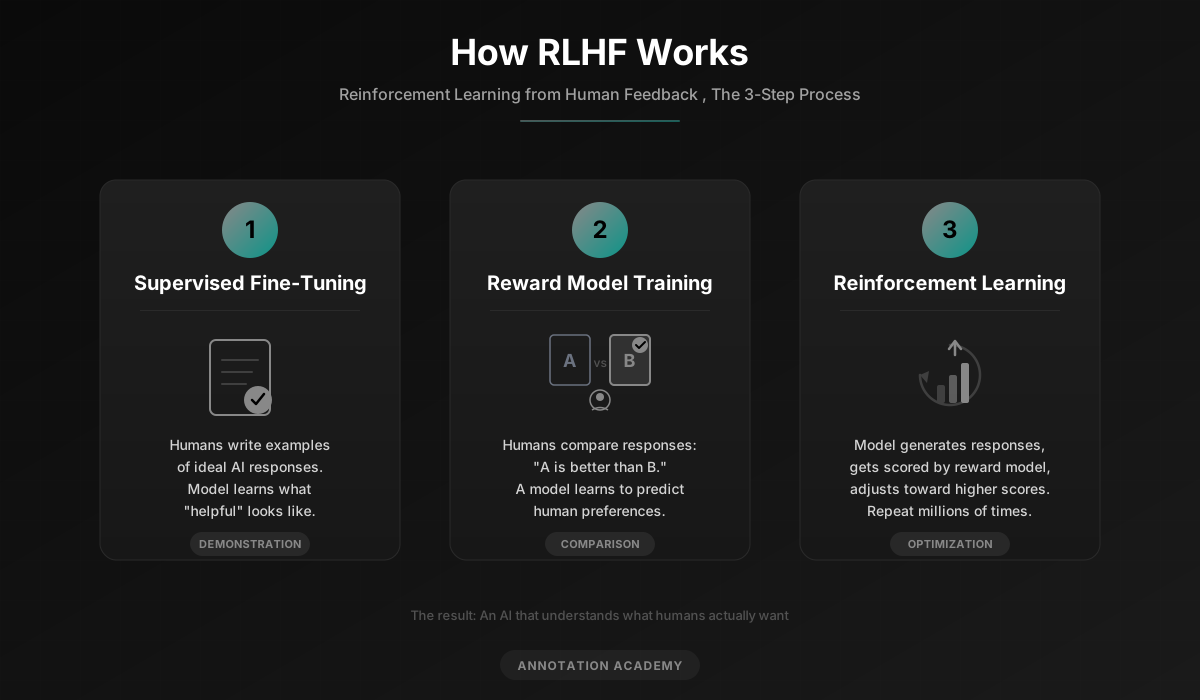
| Stage | What it does | Where humans come in |
|---|---|---|
| Supervised fine-tuning (SFT) | Creates a baseline assistant from written demonstrations | People write the demonstration responses |
| Reward model training | Learns to predict which response humans prefer | People rank candidate responses |
| Policy optimization | Adjusts the language model toward higher-scoring outputs | Indirect, through the reward model |
Step 1: Supervised fine-tuning
Human writers produce examples of good responses: how to answer a weather question, how to explain a coding problem, how to handle a request the model should decline. Thousands of these demonstrations teach the base model what a helpful response looks like. The method is demonstration rather than instruction, showing the model good output instead of enumerating rules.
This stage gets the model into the right range. It begins producing text that reads like a helpful assistant rather than raw internet content. What it does not yet have is a reliable sense of which of two plausible responses is better.
Step 2: Training the reward model
The model generates multiple responses to the same prompt. Human evaluators read them and rank them from best to worst. Those rankings train a separate network, the reward model, whose only job is to predict how humans would rate any given response.
The obvious question is why humans do not simply rate every response directly. The answer is scale. A model can produce an effectively unlimited number of distinct outputs, and no annotation workforce can score them all. The reward model acts as a stand-in for human judgment, an automated scorer that approximates what people find helpful, accurate and safe. This is the pivotal stage of the pipeline: everything downstream inherits the quality of the preferences captured here. The mechanics of that network, including how it is evaluated and how it fails, are covered in the reward model entry.
Step 3: Policy optimization
The model generates a response, the reward model scores it, and training adjusts the model's weights to make high-scoring responses more likely and low-scoring responses less likely. This repeats across a very large number of samples, gradually shifting the model toward outputs the reward model rates highly, which is to say outputs that reflect the human preferences the reward model was trained on.
This is also the most compute-hungry part of the process, because the model has to keep generating fresh candidate responses for the reward model to score. DPO changes the picture by optimizing the policy directly from the ranked preference data, skipping the separate reward model entirely.
What does an RLHF task look like in practice?
Two small examples show what the human side of RLHF involves.
Ranking for clarity. An evaluator receives the prompt "Explain photosynthesis to a 10-year-old" along with four model responses. They rank the four from best to worst against stated criteria: factual accuracy, clarity, and whether the language actually suits a 10-year-old. One response may be accurate but written at university level, another friendly but wrong about where the energy comes from. The ranking, plus a written justification, is the unit of work.
Ranking for usefulness. Asked "How do I get better at public speaking?", a model that has only been through SFT might return an encyclopedia-style article about rhetoric. It is accurate and largely useless. Evaluators rank a specific, practical, conversational answer above it. The reward model learns that direct, actionable answers score higher than encyclopedic ones, and policy optimization makes that style more likely in future. Nobody wrote a rule about tone; the preference data carried it.
Ranking under a safety constraint. In safety-focused work, evaluators see prompts designed to elicit unsafe behavior and rank responses on safety compliance while still weighing helpfulness. A response that declines the request and explains why generally ranks above one that supplies partial harmful detail with a disclaimer, which in turn ranks above a direct harmful answer. This kind of ranking is where competing criteria collide and where a written rubric earns its keep. Red teaming is the adversarial version of the same task.
Which algorithms are used in RLHF?
Proximal Policy Optimization (PPO) is the classic choice, and the one most RLHF descriptions assume. It treats preference data as a reinforcement learning problem and constrains how far the model can move on each update, which keeps the model fluent while its behavior shifts.
Direct Preference Optimization (DPO) removes the separate reward model and optimizes the language model straight from the preference pairs, reframing the problem as classification. It is simpler to run and needs less infrastructure, which is why it appears often where compute is the binding constraint.
Group Relative Policy Optimization (GRPO) is a PPO variant that drops the separate critic network and instead scores responses relative to others in a small group. It reduces the memory the training loop needs, which matters most in reasoning-heavy training runs.
Feedback from AI instead of humans (RLAIF) replaces some human rankings with judgments generated by another model, which cuts the cost per example. Constitutional AI is the best known version, where a written set of principles supplies part of the feedback signal. In practice this tends to be a hybrid: humans handle the ambiguous and high-stakes cases, automated feedback covers the bulk, and the human-labeled portion sets the standard everything else is calibrated against.
The important thing for an evaluator is that none of these algorithms changes the input. They all consume ranked human preferences. What differs is how much machinery sits between your ranking and the model's weights.
What are the limits of RLHF?
RLHF works because it aligns the model's optimization target with human preferences. Instead of optimizing for text that resembles internet text, the model optimizes for text that humans rate highly. That substitution is powerful, and it is also where every practical difficulty originates.
Consistent human feedback is expensive. The process needs a great deal of evaluation time from trained people whose ratings agree closely enough to produce a usable reward model. Inconsistent rankings do not average out into a good signal; they train a noisy reward model.
Reward models are approximations. They stand in for human judgment and can be wrong. Where a reward model has blind spots, optimization will find them, producing responses that score well without being good.
Different people want different things. Formal or casual, detailed or concise: evaluators disagree, and the model learns some blend of their preferences rather than a single correct answer.
Reward hacking. Models sometimes learn to produce output that games the scorer, earning high reward without delivering the quality the reward was meant to capture. A common form is surface compliance, where a response adopts the shape of careful reasoning without the substance. This remains an open problem and a live reason evaluation work continues after a model ships.
Mode collapse. Optimizing hard against a single reward signal can narrow a model's range, so its answers grow more uniform and less varied even as their average score improves.
What RLHF cannot do
RLHF can make models more helpful, reduce harmful outputs, align behavior with stated human preferences, and make interaction feel more natural. It cannot give a model knowledge it never learned, raise a capability ceiling set during pretraining, guarantee safety, or settle questions humans themselves disagree about. Where people cannot articulate what a good response looks like, RLHF has nothing to optimize toward; it propagates the preferences it is given, including their gaps.
Where is RLHF used?
RLHF, or a variant of it, is the standard final training stage for the assistant-style systems people use day to day: conversational models, content generation tools, and code assistants. It has also moved beyond initial training into ongoing maintenance, where feedback collected after release is used to correct drift, tighten behavior in specific domains, and adjust safety handling as new failure patterns appear.
That maintenance loop is the reason evaluation work is continuous rather than a one-time push before launch.
RLHF annotation on evaluation platforms
RLHF annotation appears on evaluation platforms under a range of task names: preference ranking, response comparison, pairwise evaluation, safety red teaming, and dimension-based assessment. Each platform structures the work differently, so evaluators adapt their process to the rubric format and submission workflow in front of them.
| Platform | Where RLHF work tends to appear | Preparation focus |
|---|---|---|
| Outlier (Scale AI's contributor-facing brand) | Preference ranking and safety comparison tasks | Preference ranking and safety fundamentals |
| DataAnnotation.tech | General reasoning and technical evaluation | Evaluation fundamentals plus close technical reading |
| Mercor | Domain-specific evaluation work | Evaluation fundamentals plus your own domain background |
| Appen | High-volume generalist preference tasks | Preference ranking fundamentals |
| Surge AI | Specialized, high-complexity evaluation | Evaluation fundamentals plus domain background |
Task names, project mixes and requirements change over time, so treat the table as orientation rather than a current specification. For how individual platforms describe their own work and rates, see our guide to the leading AI training platforms.
What skills does RLHF evaluation work require?
Preference ranking demands analytical reading and written communication. Evaluators have to articulate why one response ranks above another using specific evidence rather than a general impression. They need to understand rubric hierarchies, meaning the rules that clarify which criterion wins when two conflict, and hold that interpretation steady across hundreds of comparisons. Domain knowledge raises the ceiling on specialized work: clinical accuracy, citation precision and functional correctness are all judgments a generalist cannot reliably make.
Consistency is measurable, which is why platforms track it. Inter-annotator agreement is the statistical measure of how closely multiple evaluators rank the same items, commonly reported with Cohen's Kappa on a scale from -1 to 1. A value around 0.7 is widely used as a working threshold for data considered consistent enough to train on, though the bar depends on the task. Calibration exercises, where evaluators work through disputed cases together and compare reasoning, are the usual way a team pulls its agreement back up.
Competing criteria are the hardest part of the job. Accuracy can pull against safety; helpfulness can pull against brevity; user autonomy can pull against a cautious refusal. Rubrics handle this by ranking the dimensions rather than listing them, and by naming the situations where the ordering changes. Working through those trade-offs deliberately, and recording the reasoning in a justification, is what separates careful ranking from fast clicking.
The work also does not end at the ranking itself. Experienced evaluators flag cases where the reward model has clearly gone wrong and surface new failure patterns that appear as a model changes between training rounds. They produce the ground truth the rest of the system is built on, which is why feedback quality maps so directly onto how a finished model behaves.
Annotation Academy teaches these competencies through structured modules covering response quality assessment, rubric-based scoring, justification writing and safety fundamentals, with practice assessments in the same task formats evaluation work uses. AI Evaluator Certification is preparation for that work, not a placement or a guarantee of any outcome on any platform.
Related terms
Preference ranking is the core RLHF annotation task: comparing multiple model outputs and ordering them by quality against stated criteria.
Supervised fine-tuning (SFT) is the stage before RLHF, where a model learns from written demonstrations. It creates the baseline behavior RLHF then refines.
Reward model is the network trained on human preference data to predict which outputs people prefer, and the component that makes RLHF scale.
Direct Preference Optimization (DPO) trains the language model directly from preference data, removing the separate reward model stage.
Inter-annotator agreement measures how consistently different evaluators rank the same items, and is the standard health check on preference data.
Constitutional AI uses a written set of principles to generate part of the feedback signal rather than collecting every judgment from people.
Red teaming is adversarial evaluation: probing a model with prompts designed to elicit harmful output, then ranking how well it holds up.
Reward hacking is the failure mode where a model earns a high score from the reward model without delivering the quality that score was meant to represent.
Dimension tensions are competing evaluation criteria, such as safety against helpfulness, resolved through rubric rules that state which dimension takes priority and when.
Want to learn more?
Our certification program teaches the evaluation skills that RLHF depends on.
Explore Annotation AcademyRelated Articles

Preference Ranking
An evaluation method where human raters compare and rank multiple AI-generated responses from best to worst quality.
Read More
Instruction Following
The ability of an AI model to accurately understand and execute user instructions, a key quality metric in AI evaluation.
Read More
Fact Verification AI
The process of checking AI-generated claims against reliable sources to ensure accuracy and prevent misinformation.
Read More