1.0 Core Competencies of AI Evaluators
Study Time: 60 minutes Prerequisites: None Learning Objectives:
- Understand the 4 core competencies that define successful AI evaluators
- Learn to manage cognitive load for sustained evaluation quality
- Develop systematic approaches to evaluation work
- Build awareness of personal drift signals and fatigue management
Introduction
AI evaluation work comes down to five skills: writing complex prompts, drafting the ideal response, building objective rubrics, grading AI answers, and justifying every call. The modules ahead train each one in depth.
Underneath all five sit the same four core competencies, and this module is about them.
Successful AI evaluators aren't successful because they know a lot about AI. They're successful because they master these four.
If you already do evaluation work, read on with your last reviewer feedback in mind.
The Precedence Rule
Everything in this course is a default, not a mandate.
Every project publishes its own guidelines: task instructions, rubric conventions, formatting rules, definitions of quality. Those guidelines outrank this course, without exception.
| Priority | Source | When it applies |
|---|---|---|
| 1 | Project guidelines as written | Always. Where they conflict with anything taught here, the guidelines win. |
| 2 | Clarification from the project team | When guidelines are ambiguous or silent on something that changes your answer. Ask; do not infer. |
| 3 | The defaults in this course | When guidelines are silent and the question is not material enough to escalate. |
Why this matters more than it sounds. A contributor who applies a taught default over a stated project rule produces work that is confidently and consistently wrong. Consistency makes it worse: the same error repeats across every task in the batch, and reviewers spot the pattern immediately.
Your job is to execute guidelines as written, not to improve them mid-task. If a guideline looks wrong, raise it through the project's channel. Do not silently substitute your own standard.
What this course is for: defaults good enough to work from when guidelines are silent, and the vocabulary to absorb guidelines quickly when they are not.
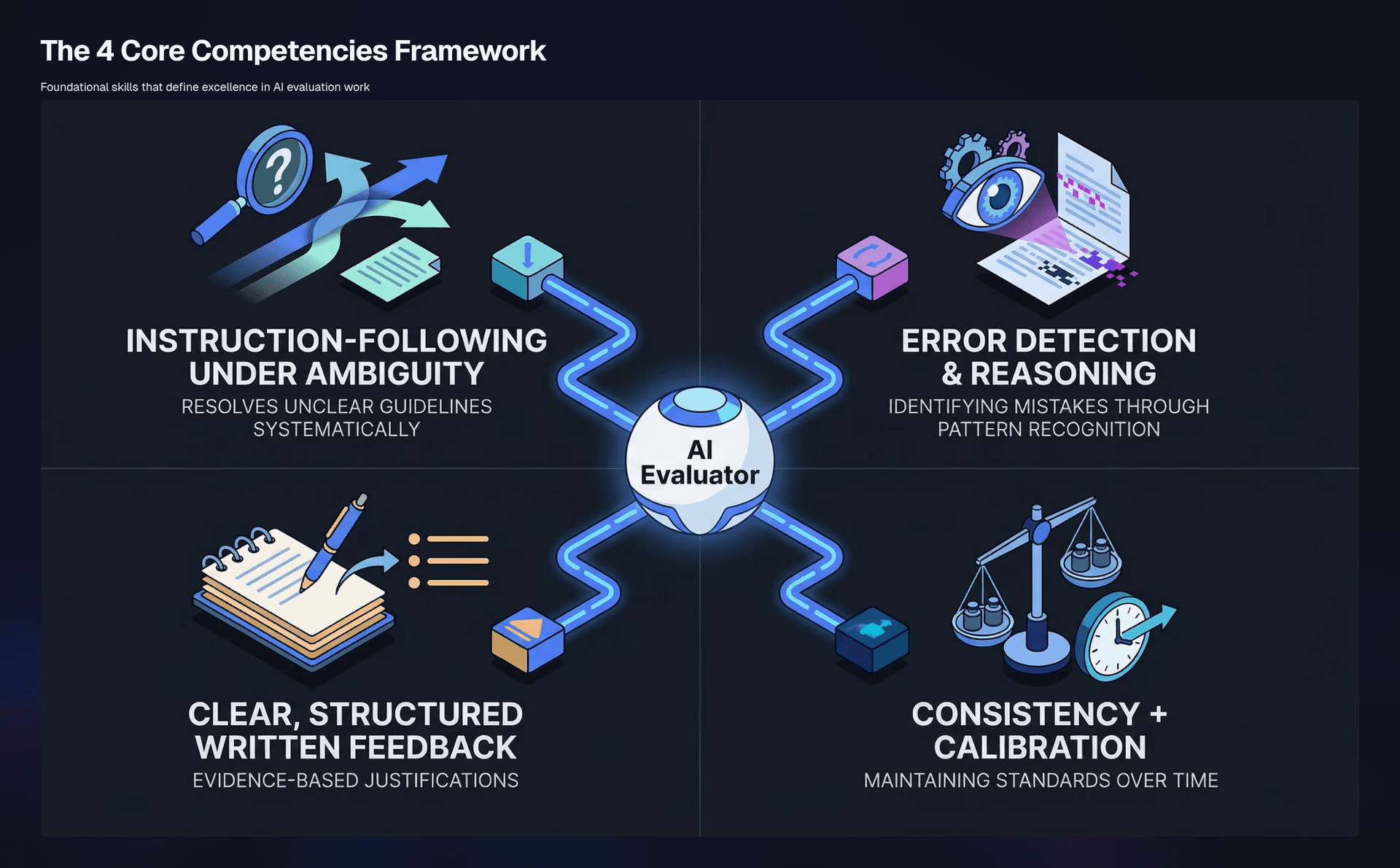
1.0.1 The 4 Core Competencies
AI evaluation platforms hire for these skills. Verify specific expectations in your project guidelines.
1. Instruction-Following Under Ambiguity
What it means: You can extract what's actually required from unclear, incomplete, or conflicting instructions.
Real evaluation guidelines are messy. They'll say "evaluate for helpfulness" without defining helpfulness. They'll have edge cases that contradict the main rule. They'll assume context you don't have.
Bad evaluators freeze when guidelines are unclear, or worse, they guess and apply their personal interpretation inconsistently.
Good evaluators develop systematic approaches to resolving ambiguity: they identify implicit requirements, they test edge cases, they ask clarifying questions when truly stuck, and most importantly, they apply their interpretation consistently.
Example:
Guideline: "Prefer responses that are concise but complete."
This is ambiguous. When does brevity become incompleteness? You don't know. But you CAN:
- Establish a personal definition based on examples in training
- Apply it consistently across all your evaluations
- Document edge cases for your own reference
- Recalibrate when you receive feedback
This skill develops through: Prompt analysis modules, rubric interpretation, gating test preparation
2. Error Detection & Reasoning
What it means: You can spot what's wrong (or right) in an AI response and explain why it matters.
AI responses fail in predictable ways: factual errors, logical inconsistencies, missed nuance, hallucinated sources, unsafe suggestions. Your job is to catch these failures and classify their severity.
Bad evaluators either miss errors entirely or flag things as "wrong" without understanding why.
Good evaluators develop pattern recognition for common AI failure modes. They verify claims efficiently. They distinguish between "technically incorrect" and "functionally wrong." They calibrate severity appropriately.
Example scenarios you'll encounter:
| AI Response | Error Type | Why It Matters |
|---|---|---|
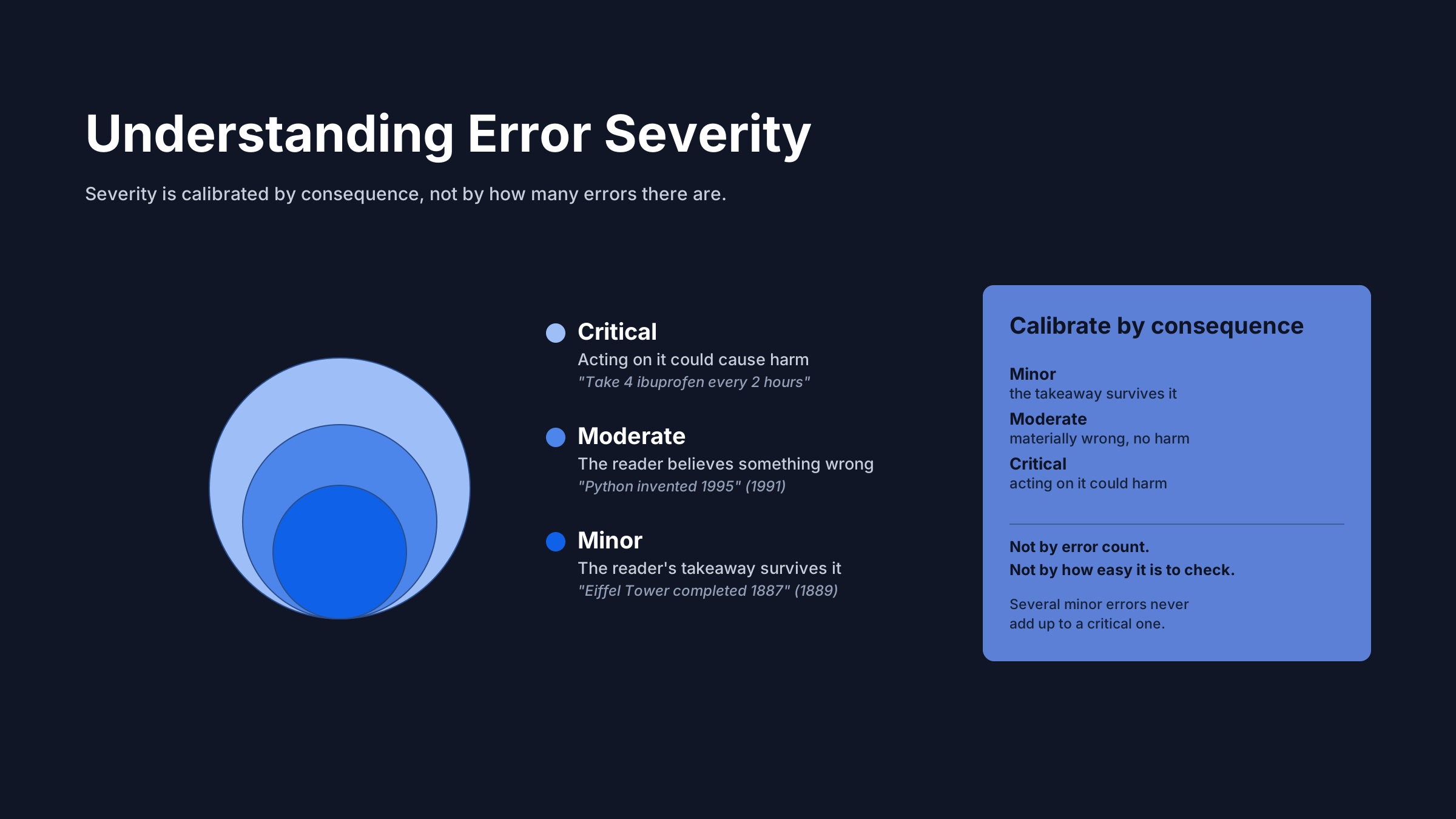
| "The Eiffel Tower was completed in 1887" | Factual error (actually 1889) | Minor, close enough for casual use |
| "Take 4 ibuprofen every 2 hours for pain" | Dangerous error | Critical, exceeds safe dosing |
| "Python was invented in 1995 by Guido van Rossum" | Partially wrong (1991, correct author) | Moderate, misleading but not harmful |
| "Studies show coffee prevents cancer" | Overstated/unsourced claim | Moderate, creates false certainty |
Placing an error on the spectrum: severity is calibrated by consequence, not by error count and not by how easy the error is to check. An error is minor when the reader's takeaway survives it: the claim is close enough that acting on it changes nothing, like a date a couple of years off in an incidental fact. An error is moderate when the reader walks away believing something materially wrong, such as a mislabeled fact or an overstated, unsourced claim that creates false certainty, but acting on it causes no direct harm. An error is critical when acting on the response could cause harm, as with unsafe dosing or dangerous instructions. Minor errors are still errors: you record them, then rank them appropriately. Several minor errors do not add up to a critical one; a single dangerous claim outweighs any number of small slips.
This skill develops through: Fact-checking modules, evaluation dimension training, rubric application
3. Clear, Structured Written Feedback
What it means: You can explain your evaluation decisions in writing that others can understand and act on.
When you choose Response A over Response B, you'll write a justification. When you mark a response as "incorrect," you'll explain why. When you create a rubric criterion, you'll define it clearly.
Bad evaluators write vague justifications: "B is better because it's more helpful" or "A has issues."
Good evaluators structure feedback with evidence:
- Verdict: Response B is better
- Primary reason: B provides specific examples while A stays abstract
- Evidence: A says "there are several methods" but doesn't name them. B lists three methods with use cases.
- Secondary factors: Both are accurate, but B is better formatted
This skill develops through: Justification writing module, rubric creation, and the platform workflow module
4. Consistency + Calibration
What it means: You evaluate similar tasks similarly, and your standards align with project expectations.
If you rate Response X as "excellent" on Monday and an identical response as "adequate" on Wednesday, you're inconsistent. If you think a response is "good" but the platform marks it as "poor," you're miscalibrated.
Bad evaluators drift over time. Their standards change based on mood, fatigue, or recent examples. They don't notice when they've drifted.
Good evaluators actively maintain consistency through self-checks, decision journals, and calibration with gold standards. They notice when their standards have shifted and correct course.
Example of calibration:
Your rating: Response is a 4/5 (Good)
Platform gold standard: 2/5 (Poor)
A miscalibrated evaluator thinks "the platform is wrong." A calibrated evaluator thinks "I'm missing something, let me figure out what the platform values that I don't."
This skill develops through: The self-audit and calibration practice built into the rubric and gating-test modules, plus gold standard analysis
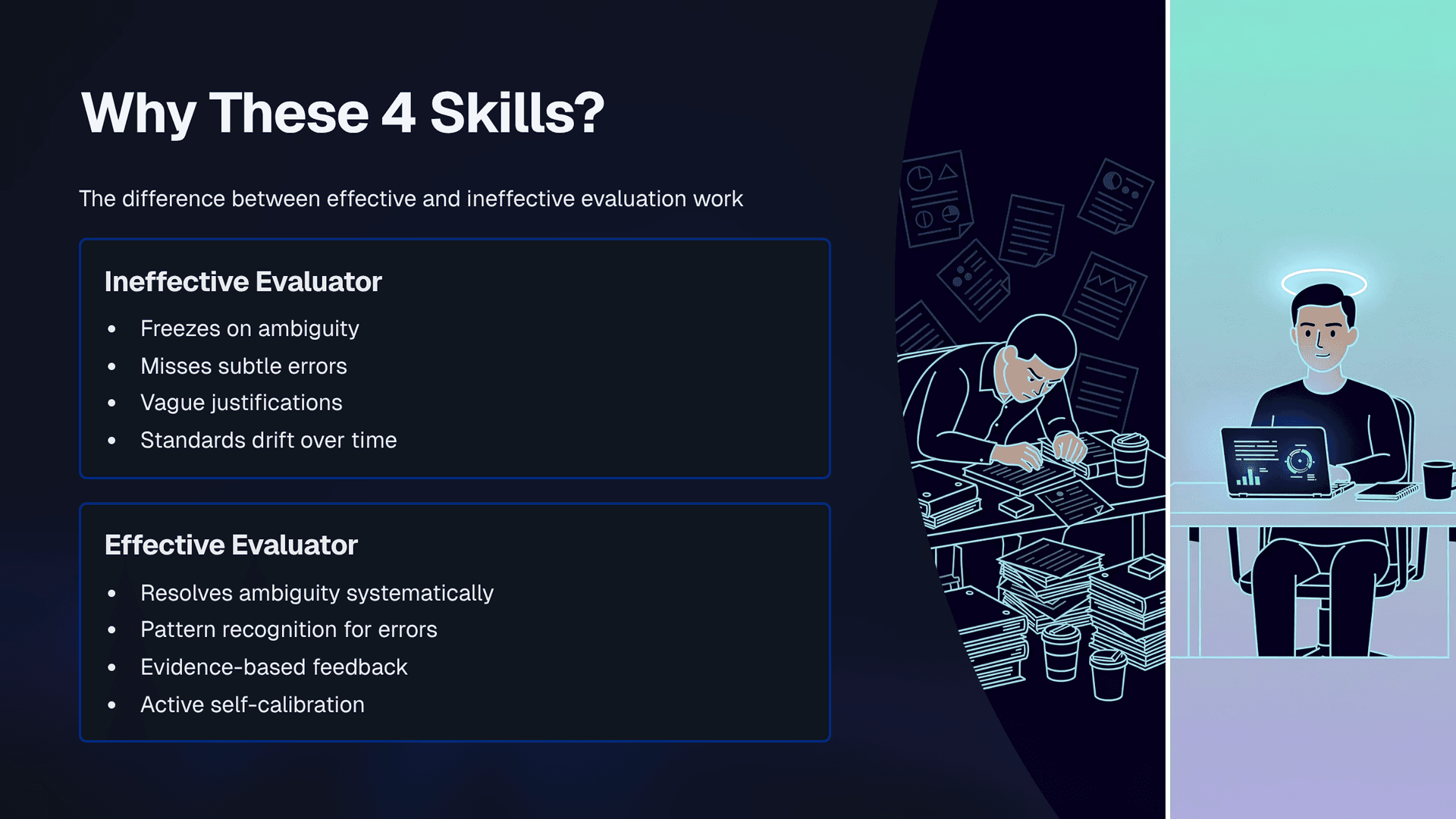
Why These 4 Skills?
Notice what's NOT on this list:
- Understanding how transformer models work
- Knowing what GPT stands for
- Being able to explain RLHF algorithms
- Programming skills
Those things don't matter for 95% of evaluation work.
What platforms actually need:
- People who can read messy instructions and extract consistent rules
- People who can spot errors and severity-rank them appropriately
- People who can document their reasoning clearly
- People who maintain quality over thousands of repetitive tasks
This is fundamentally human work. AI can't do it (yet), because the job is teaching AI to be better. You're the training data.
How This Curriculum Develops These Competencies
Every module you complete strengthens one or more of these four competencies:
| Module Type | Primary Competencies Developed |
|---|---|
| Prompt analysis & understanding | #1 (Instruction-following) |
| Fact-checking & error detection | #2 (Error detection) |
| Justification & rubric writing | #3 (Clear feedback) |
| Self-audit & calibration | #4 (Consistency) |
| Evaluation dimensions | #2, #3 |
| Safety fundamentals | #2, #4 |
| Professional practice | All four |
By the end of this certification, you'll have functional competency in all four areas, and the later modules sharpen each one into working mastery.
Common Misconceptions
Misconception 1: "I need to be an AI expert to do this work" Reality: AI expertise helps in specialized domains (like code evaluation), but the core skills are human judgment skills.
Misconception 2: "Good evaluators have better intuition" Reality: Good evaluators have better systems. They've trained systematic approaches that produce consistent results.
Misconception 3: "This work is subjective" Reality: Individual judgments have subjectivity, but systematic methodology + calibration produces objective outcomes. Platforms measure this with inter-annotator agreement scores.
Misconception 4: "Platforms want fast evaluators" Reality: Platforms want consistent, accurate evaluators. Speed comes from practice, but quality always comes first.
1.0.2 Managing Your Mental Resources
The Hidden Challenge of Evaluation Work
You'll spend hours reading AI-generated text, making nuanced judgments, and documenting decisions. This is cognitively demanding work.
Most new evaluators don't fail because they can't understand the guidelines. They fail because they run out of mental energy halfway through a session and start making sloppy decisions.
The Three Types of Mental Load
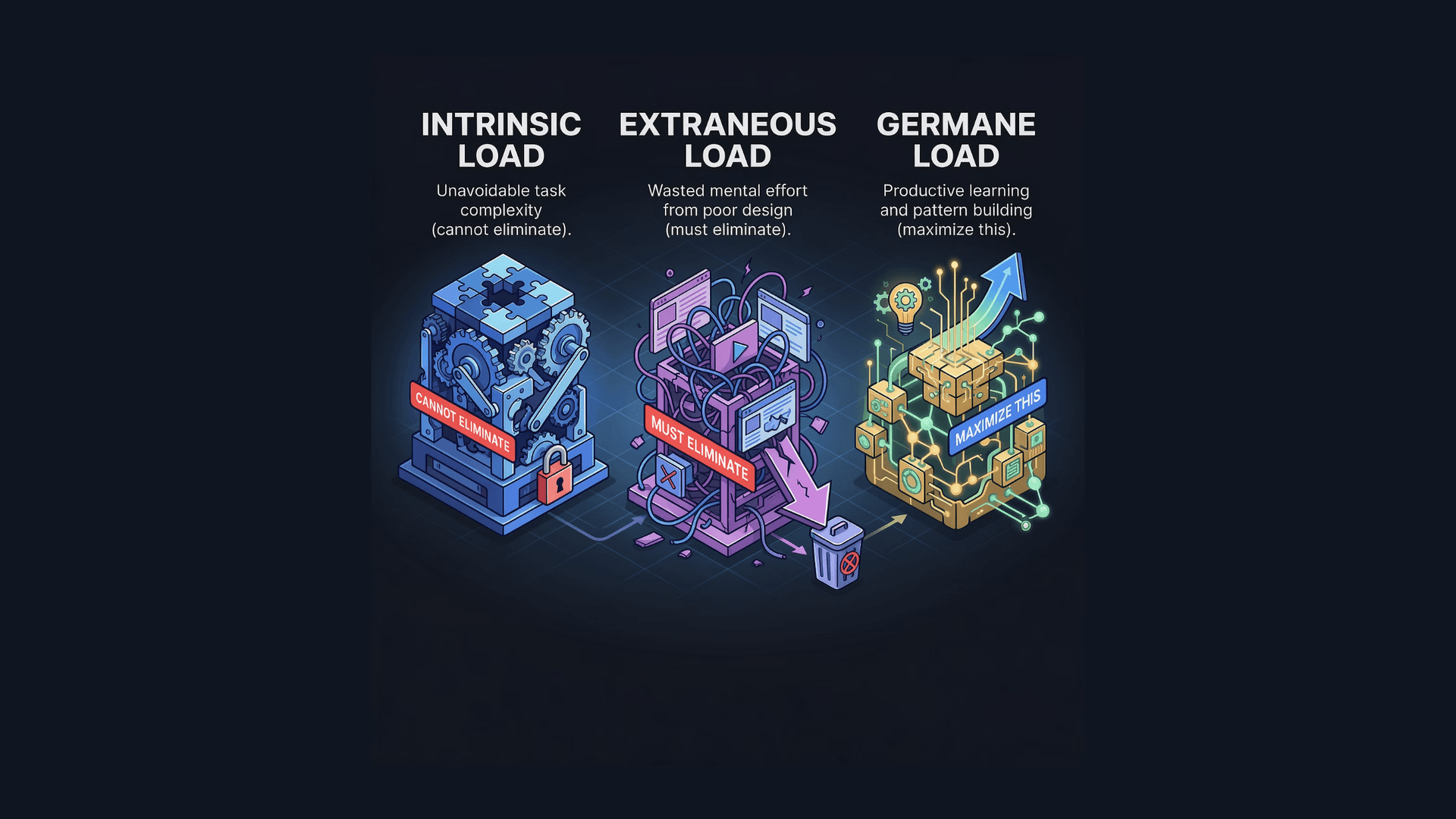
Cognitive Load Theory (CLT) identifies three types of mental effort:
1. Intrinsic Load (Task Complexity)
What it is: The inherent difficulty of the task itself.
Evaluating "Is 2+2=4?" has low intrinsic load. Evaluating "Does this medical response contain dangerous advice?" has high intrinsic load.
You cannot eliminate intrinsic load, it's part of the work. But you can prepare for it.
Practical application:
- Schedule harder tasks when you're fresh (morning if you're a morning person)
- Take breaks before high-intrinsic-load tasks, not after
- Don't attempt complex evaluations when you're already mentally fatigued
2. Extraneous Load (Wasted Effort)
What it is: Mental effort spent on things that don't contribute to learning or task completion.
This is the enemy. Extraneous load is pure waste.
Common sources of extraneous load in evaluation work:
| Source | Example | Fix |
|---|---|---|
| Poor workspace setup | Switching between 5 browser tabs to see guidelines | Use a second monitor or print guidelines |
| Unclear instructions | Re-reading guidelines 3 times trying to understand | Highlight unclear parts, document your interpretation |
| Distractions | Checking phone, responding to messages | Dedicated work sessions with notifications off |
| Decision fatigue from trivial choices | "Should I use this synonym or that one in my justification?" | Create templates for common justification structures |
| Bad formatting | Guidelines in dense paragraph form | Create your own reformatted quick-reference |
Reducing extraneous load frees mental capacity for the actual evaluation work.
3. Germane Load (Productive Learning)
What it is: Mental effort spent building expertise and improving your evaluation schema.
This is good load. It's the effort of learning patterns, building mental models, and developing systematic approaches.
Goal: Over time, reduce extraneous load and convert your mental effort into germane load.
Practical Strategies for Managing Cognitive Load
Strategy 1: The First-Task-Slow Principle
Problem: Rushing through your first task creates errors that cascade.
Solution: Your first evaluation of a session can take 2x as long as normal. This is expected.
Why it works:
- You recalibrate to the project's standards
- You refresh your memory of edge cases
- You warm up your evaluation "muscles"
- You catch any guideline changes since your last session
Example routine:
- Read guidelines once completely (even if you know them)
- Do your first task at 50% of target speed
- Self-review your work before submitting
- Only then proceed to normal pace
Strategy 2: Break Protocols
Problem: Evaluation work is repetitive. The longer you rate without a break, the more your judgment degrades.
Solution: Regular breaks. There is no scientifically fixed break schedule. Research suggests short breaks of up to about 10 minutes reliably reduce fatigue and restore energy, and longer breaks help performance more.
The course default:
- Take a short break (5-10 minutes, away from the screen) at least every 25-50 minutes of focused rating
- Take a longer break (15-20 minutes) after roughly 90 minutes of work
- Stop sooner if you notice drift signals (see Strategy 5)
Many people feel an energy dip around the 90-minute mark, but treat that as a rule of thumb, not a law. Two common ways to apply the default:
The 50/10 Rule (for standard tasks):
- 50 minutes of focused work
- 10 minutes of true break (away from screen)
- After roughly 90 minutes of work, make the next break a longer one (15-20 minutes)
The 25/5 Rule (for high-complexity tasks):
- 25 minutes of focused work
- 5 minutes of break
- After 3 or 4 cycles (roughly 90 minutes of work), take a longer 15-20 minute break
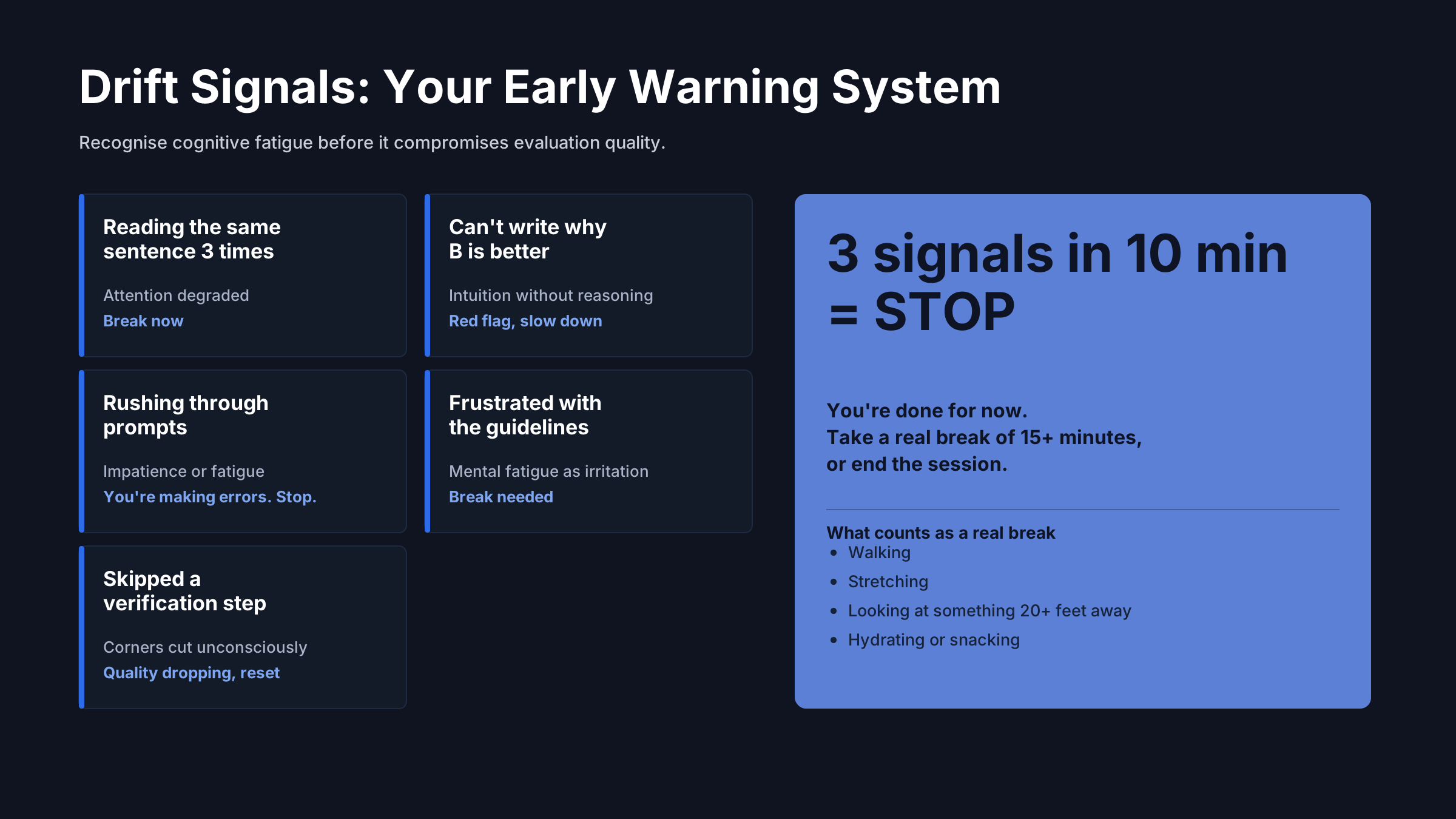
What counts as a real break:
- Walking
- Stretching
- Looking at something 20+ feet away (eye rest)
- Hydrating/snacking
What doesn't count:
- Scrolling social media (still mental load)
- Checking email (decision load)
- Reading anything text-heavy
Strategy 3: Decision Journaling for Edge Cases
Problem: You encounter an ambiguous case, spend 5 minutes deciding, then forget your reasoning. The next similar case, you spend another 5 minutes.
Solution: Keep a lightweight decision journal.
Format:
Date: 2024-03-15
Task Type: Medical advice responses
Edge Case: User asks "how do I treat a minor burn", both responses suggest home treatment
Decision: Chose the one that included "see a doctor if X, Y, Z" even though the other was more detailed
Reasoning: Safety disclaimer is implied criterion for medical content
Project Standard: This aligns with reviewer feedback from last week
Time investment: 60 seconds per edge case Time savings: 5+ minutes every time that edge case recurs Cognitive load reduction: Eliminates re-decision overhead
Strategy 4: Template-Based Justification Writing
Problem: You spend mental energy on sentence structure instead of content.
Solution: Create justification templates for common scenarios.
Example templates:
For binary comparison:
Response [A/B] is better overall.

Primary advantage: [Response excels at X criterion because Y evidence]

Secondary factors: [Brief mention of other considerations]

Verdict: [Clear declaration]
For accuracy errors:
This response contains [minor/moderate/critical] factual errors:

Error 1: States [incorrect claim]. Actually, [correct information]. Source: [where you verified]

Impact: [Why this matters / severity assessment]
Why this works: You're not being lazy, you're pre-solving the extraneous load problem of "how do I phrase this?" so you can focus on "what is my actual reasoning?"
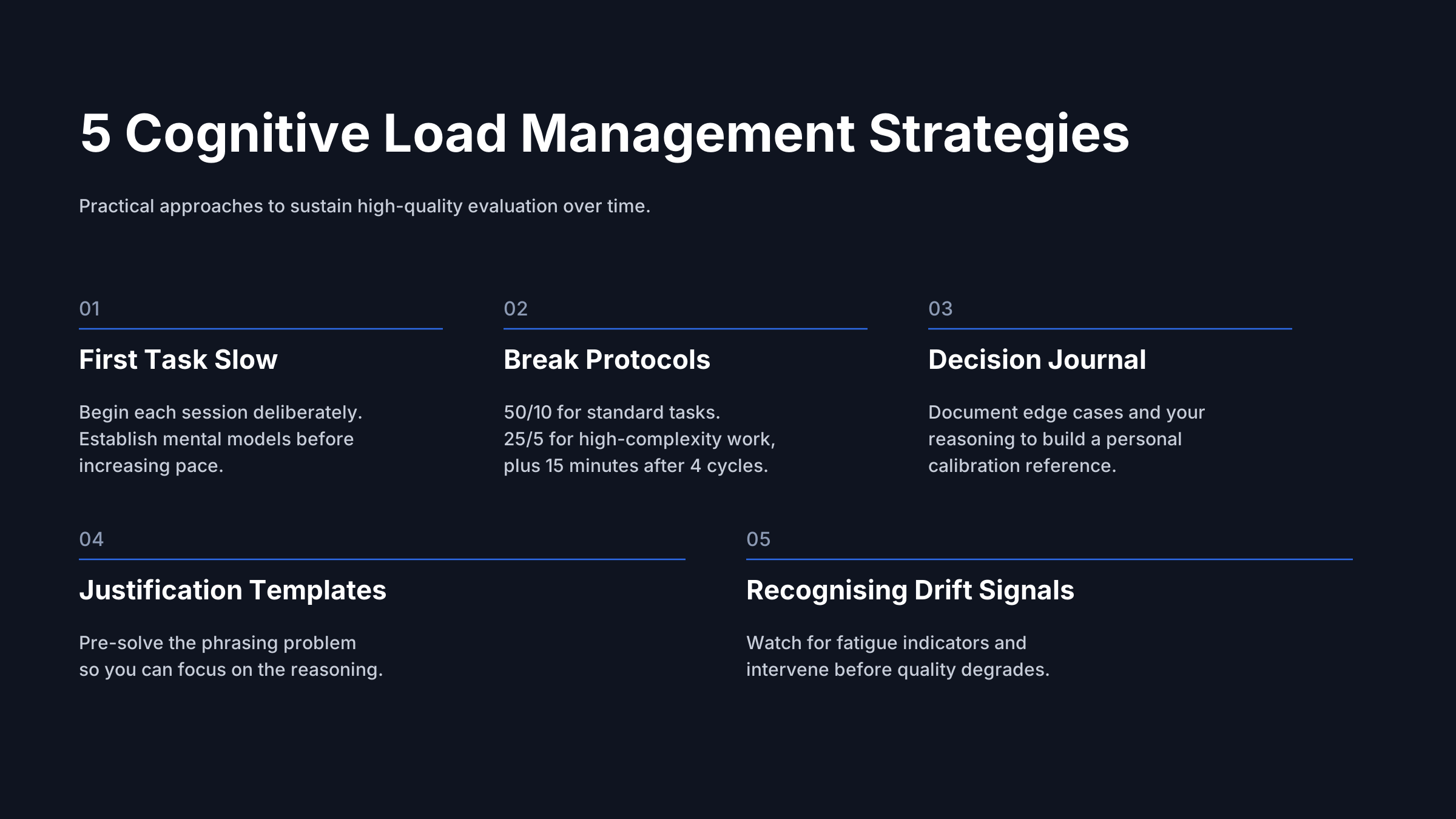
Strategy 5: Recognizing Your Drift Signals
Problem: You don't notice when your judgment quality has degraded.
Solution: Learn your personal cognitive fatigue signals.
Common drift signals:
| Signal | What It Means | Action |
|---|---|---|
| Reading same sentence 3 times | Attention degraded | Break now |
| Choosing "B is better" but struggling to write why | Intuition without reasoning | Red flag, slow down |
| Rushing through prompts | Impatience/fatigue | You're making errors. Stop. |
| Getting frustrated with guidelines | Mental fatigue manifesting as irritation | Break needed |
| Noticing you skipped a verification step | Corners being cut unconsciously | Quality dropping, reset |
The 3-strike rule: If you notice 3 drift signals in 10 minutes, you're done for now. Take a real break (15+ min) or end the session.
Evaluating AI Responses for Cognitive Load
Part of your job is evaluating whether AI responses impose unnecessary cognitive load on users.
Good responses minimize extraneous load:
- Clear structure (headers, bullets, logical flow)
- Appropriate length (not bloated)
- No jargon when simpler words work
- Examples when concepts are abstract
Bad responses impose unnecessary load:
- Wall of text with no structure
- Overly technical when user is clearly a beginner
- Verbose explanations when user wanted concise answer
- Multiple complex ideas introduced simultaneously without scaffolding
Self-Assessment
Before moving forward, honestly assess your current level:
Instruction-following under ambiguity:
- I can extract requirements from unclear instructions
- I notice when guidelines have gaps or contradictions
- I apply my interpretation consistently
Error detection & reasoning:
- I can spot factual errors in unfamiliar domains
- I can distinguish critical errors from minor ones
- I can explain why something is wrong, not just that it is
Clear written feedback:
- I can articulate my reasoning in writing
- Others can understand my explanations without asking follow-up questions
- I use evidence to support my claims
Consistency + calibration:
- I evaluate similar tasks similarly
- I notice when my standards have drifted
- I actively recalibrate when receiving feedback
If you checked fewer than 8 of these boxes, this curriculum will develop these skills from scratch.
If you checked 8+ boxes, this curriculum will systematize and refine skills you already have informally.
Key Takeaways
- AI evaluation success comes from 4 human skills, not AI knowledge, Instruction-following, Error detection, Clear feedback, Consistency
- These are learnable, trainable skills, not innate talents
- Manage cognitive load professionally, reduce extraneous load, use break protocols, respect drift signals
- Three types of mental load: Intrinsic (task itself), Extraneous (waste), Germane (learning)
- Use templates and decision journals, they free mental capacity for actual evaluation work
- The first task is often slow, recalibrate before speeding up
Next Steps
- Module 1.1: How AI Training Works
- Complete Module 1.0 Assessment
Module 1.0 Complete
This module is free
Create a free account to start
Save your progress, take the practice drills and quiz, and unlock the video walkthrough plus Kappa, your AI study partner. No card required.