Is AI Evaluation a Real Career? What the Job Market Actually Looks Like

A few years ago, "AI evaluator" wasn't a job title anyone recognized. Now there are tens of thousands of people doing this work globally. But is it a real career, or just a temporary gig before automation catches up?
I've spent enough time in this field to have some perspective. Here's an honest assessment.
The Current Job Market
The demand is real and growing. Job postings for AI evaluation and training roles have increased significantly over the past two years.
This makes sense when you consider what's happening in AI development. Every major tech company is racing to improve their AI models. That improvement requires human feedback. No one has figured out how to automate the human judgment part yet.
Current market snapshot:
- Large evaluation platforms: Regularly hiring thousands of evaluators across projects
- Established annotation companies: Steady demand for annotation and evaluation work
- Direct company hires: Major AI labs and research companies hiring evaluation specialists
- Startup ecosystem: Dozens of smaller AI companies building evaluation teams
AI evaluation positions are posted consistently across major job boards, and that's just the publicly listed roles. Many positions are filled through platforms or internal pipelines.
Career Progression
How does this work develop over time?
Entry level (0-6 months): Basic annotation and evaluation tasks. Learning the systems and building quality scores. This phase is about proving consistency and reliability.
Intermediate (6-18 months): More complex evaluation work. Access to varied project types. Potentially moving into specialized projects if you have relevant domain expertise.
Specialist (18+ months with expertise): Technical evaluation (code, medical, legal), quality assurance roles, or evaluation lead positions. Domain specialists access the most complex projects.
Full-time positions: Some companies hire dedicated evaluation staff. These roles typically require strong track records and offer traditional employment benefits.
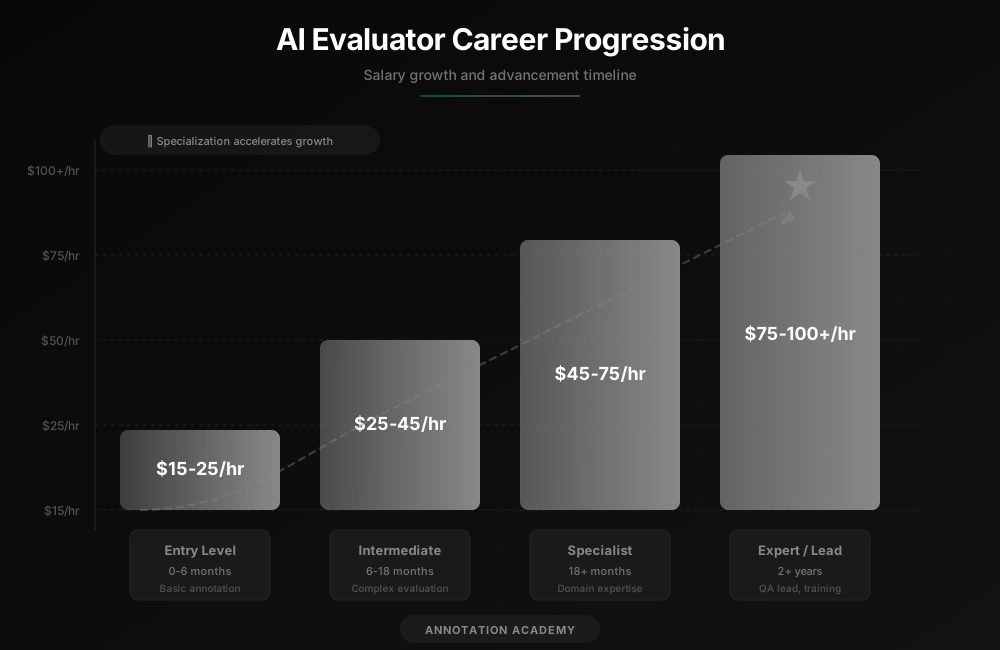
The progression is real but requires building toward it. Most evaluators who reach advanced roles did it by developing specialized skills or moving into leadership positions.
Career Progression Paths
Where do AI evaluators go from here? A few common trajectories:
Depth: Evaluation Specialist Stay in evaluation but move into increasingly specialized work. Quality assurance lead, evaluation program management, or expert evaluator for high-stakes projects.
Lateral: AI Operations Move into other AI-adjacent roles. Prompt engineering, AI testing, content strategy for AI products. The judgment skills transfer.
Upward: AI Product Roles Some evaluators move into product management or research positions at AI companies. Your understanding of model behavior becomes valuable institutional knowledge.
Adjacent: AI Training and Education Teach others to do evaluation work. Certification programs, corporate training, consulting for companies building evaluation teams.
The common thread: evaluation experience gives you insight into how AI actually works, not the theory, but the practical reality of what these models can and can't do. That insight is valuable across many roles.
The Automation Question
The elephant in the room: will AI eventually replace AI evaluators?
My honest answer: partially, but not entirely.
Here's what's likely to get automated:
- Basic annotation tasks that follow clear rules
- Simple quality checks with objective criteria
- High-volume, low-complexity evaluation work
Here's what's harder to automate:
- Judgment calls on ambiguous cases
- Evaluation of nuanced, context-dependent quality
- Catching novel failure modes that haven't been seen before
- High-stakes evaluation where errors are costly
The pattern in most automation: routine work gets automated, while work requiring human judgment persists. AI evaluation follows this pattern.
What this means practically: the job will evolve. Entry-level annotation might shrink. Complex evaluation requiring real expertise will likely grow. The evaluators who develop specialized skills and move up the value chain are better positioned.
What Makes This Different from Other Gig Work
AI evaluation gets compared to other gig economy work, but there are meaningful differences:
Skill development. Unlike driving for rideshare or basic data entry, evaluation work builds transferable cognitive skills. You get better at systematic analysis, clear reasoning, and identifying quality.
Rate trajectory. Most gig work has flat rates that don't increase with experience. Evaluation work has a real skill ladder, demonstrated quality unlocks higher-paying projects.
Industry relevance. The skills and knowledge you build are relevant to one of the fastest-growing industries. That creates optionality.
Remote by default. This has always been remote work, not remote work adapted from in-person models.
That said, it shares gig work challenges: income variability, lack of benefits on most platforms, isolation, and the need to manage your own productivity.
Who Should Consider This Work
Good fit if you:
- Need flexible, remote work that pays reasonably
- Have strong attention to detail and clear analytical thinking
- Want exposure to AI technology without needing an engineering background
- Have expertise in a field (coding, medicine, law, finance) that you can apply
- Are comfortable with work that's intellectually demanding but not always exciting
Less ideal if you:
- Need stable, predictable income immediately
- Strongly prefer in-person work environments
- Find repetitive detailed work draining
- Want a traditional career path with clear advancement
The Realistic Picture
AI evaluation is a real job with real pay and real career potential. It's not a get-rich-quick scheme, and it's not the future of work for everyone.
The work matters, you're directly shaping how AI systems behave. The pay is legitimate, better than many remote options, especially as you develop expertise. The trajectory is real, people do advance from entry-level annotation to specialized roles paying significantly more.
But it requires treating it seriously: learning the craft, maintaining quality, developing specialized knowledge, and staying current as the field evolves.
For the right person, at the right time, it can be a valuable part of a career. Not because AI evaluation is inherently special, but because developing real expertise in a growing field almost always creates opportunity.
The question isn't whether AI evaluation is a "real career." The question is whether you'll approach it in a way that builds toward something, or just treat it as a gig to fill time.
Both are valid choices. But they lead to very different places.
Ready to start building your AI evaluation career?
Annotation Academy's certification program gives you the foundation to succeed in this growing field.
Explore CertificationRelated Articles

What Is AI Evaluator Certification? The Complete Guide
AI Evaluator Certification prepares professionals to evaluate AI model outputs for leading AI companies. This guide covers costs, skills, career paths, and how to choose the right program.
Read More
AI Rater: The Complete Guide to Starting a Career in AI Training
Read More