What Does an AI Evaluator Actually Do? A Day in the Life

If you've scrolled through job boards lately, you've probably noticed something strange: tech companies are hiring thousands of people to "evaluate AI" and paying surprisingly well for it. But what does that actually mean?
I spent the last year working as an AI evaluator across multiple platforms. Here's what the job really looks like, no jargon, no hype.
The Simple Version
Every time you chat with ChatGPT, Claude, or any AI assistant, someone helped train it. That someone is an AI evaluator.
Our job is straightforward: look at what an AI produces and tell the company whether it's good or not. Did it answer the question correctly? Was the response helpful? Did it say anything weird or harmful?
That's it. We're essentially quality control for artificial intelligence.
What a Typical Day Looks Like
Most of my work falls into three categories:
Comparing responses. The AI gives two different answers to the same question. I pick which one is better and explain why. Sometimes the differences are obvious, one answer is wrong, the other is right. Other times, it's more subtle. Maybe both are correct, but one explains things more clearly.
Rating quality. I'll see a conversation between a user and an AI, then score it on things like helpfulness, accuracy, and safety. Was the information correct? Did it actually address what the person asked? These ratings feed back into the training process.
Finding problems. Sometimes I'm specifically looking for issues, responses that could be harmful, factually wrong, or just unhelpful. This is called "red teaming," and it's about stress-testing the AI to find weaknesses before real users encounter them.
Why This Job Exists
Here's something most people don't realize: AI models don't improve by themselves. They need human feedback to learn what "good" actually means.
Think about it. An AI can process millions of text examples, but it has no real understanding of whether a joke is funny, an explanation is clear, or advice is actually useful. Humans have to provide that judgment.
This process has a technical name, Reinforcement Learning from Human Feedback, or RLHF. The human feedback part? That's us. Every rating, every comparison, every piece of feedback gets incorporated into making the next version of the AI slightly better.
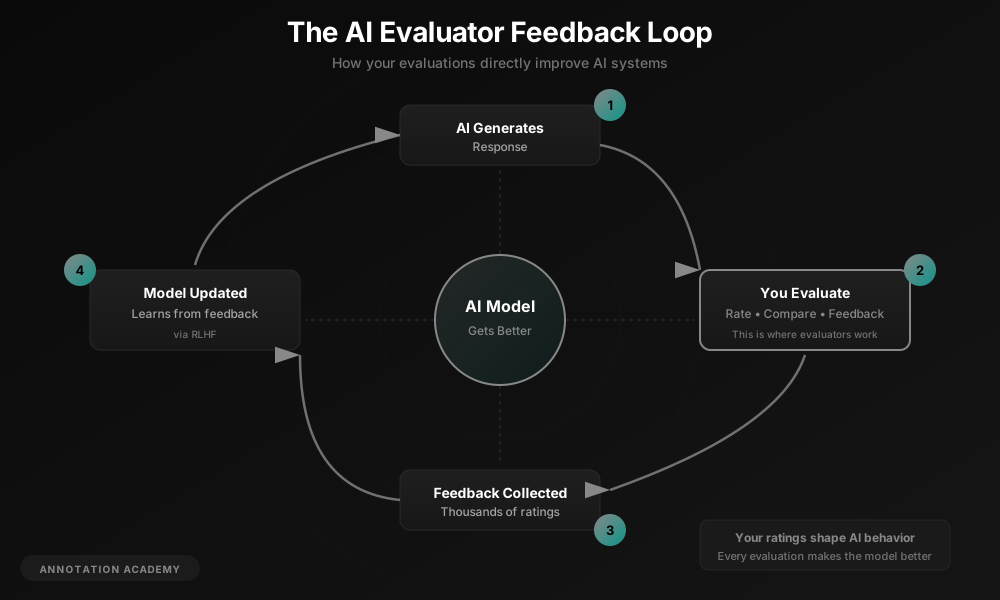
Companies like OpenAI, Anthropic, Google, and Meta spend enormous resources on this. AI evaluation positions are posted regularly across major job boards, and that number keeps growing.
The Compensation Structure
AI evaluation platforms compensate based on project complexity and evaluator experience.
Entry-level positions involve basic data annotation and labeling tasks. Important work, but not particularly complex. As you build quality scores and demonstrate consistency, you gain access to more advanced projects.
Experienced evaluators work on more complex evaluation tasks requiring deeper judgment. Domain specialists with expertise in fields like medicine, law, coding, or finance access specialized projects that require professional knowledge.
Compensation varies significantly by platform, project type, and evaluator experience level. The general pattern is that more complex work requiring specialized skills commands better rates.
Who's Hiring
Multiple platforms and companies hire AI evaluators. The ecosystem includes:
- Large-scale evaluation platforms that work with major AI labs on RLHF training data
- Specialized annotation companies focused on specific project types
- AI talent marketplaces that connect evaluators with projects
- Direct company hires at AI research labs and startups

Beyond platforms, many AI companies hire evaluators directly. Anthropic, Google DeepMind, and various startups regularly post evaluation roles.
What It Takes to Get Started
Here's the honest truth: you don't need a computer science degree. What you do need is:
Attention to detail. The work requires careful reading and precise judgment. Missing small errors or inconsistencies will hurt your quality scores.
Clear thinking. You need to articulate why one response is better than another. Vague reasoning doesn't help train AI models.
Reliability. Platforms track your accuracy and consistency. If your ratings are all over the place, you won't get much work.
Subject matter knowledge (for higher-paying roles). A background in programming, science, law, or other specialized fields opens doors to premium projects.
Most platforms have qualification tests. Pass them, maintain good quality scores, and work becomes fairly steady.
Is It Actually a Good Job?
Depends on what you're looking for.
The flexibility is real. I've worked from coffee shops, airports, and my couch at 2 AM. There's no commute, no dress code, no fixed schedule.
But it's also isolating. You're alone with your computer, making judgment calls that can feel repetitive. Some weeks there's plenty of work; other weeks it's slow. Income can fluctuate.
For students, parents, or anyone needing flexible remote work, it's genuinely valuable. For someone wanting a traditional career path with steady advancement, it's more complicated.
The Bigger Picture
What makes this job meaningful, at least to me, is knowing that our work shapes how millions of people interact with AI every day. The models getting better at answering questions, avoiding harmful content, being genuinely helpful? Human evaluators are directly responsible for that improvement.
It's strange work. You're training something that might eventually be smarter than you at many tasks. But for now, it still needs human judgment to understand what humans actually want.
And companies are willing to pay well for that judgment.
Ready to start your AI evaluation career?
Annotation Academy's certification program teaches you the exact skills platforms are looking for.
Learn More About CertificationRelated Articles

AI Evaluator Job Description: Skills, Requirements & Responsibilities
What does an AI evaluator do? Complete job description covering daily tasks, required skills, and qualifications for AI evaluation roles.
Read More
What Is AI Evaluator
Read More