The 5 Quality Dimensions: How to Evaluate Any AI Response Like a Pro

When you're evaluating thousands of AI responses, you need a systematic framework. You can't just go with "this feels better", you need to know exactly what you're looking for and why.
After working across multiple platforms, I've found that quality almost always breaks down into five core dimensions. Different platforms use different names, but the underlying concepts are consistent.
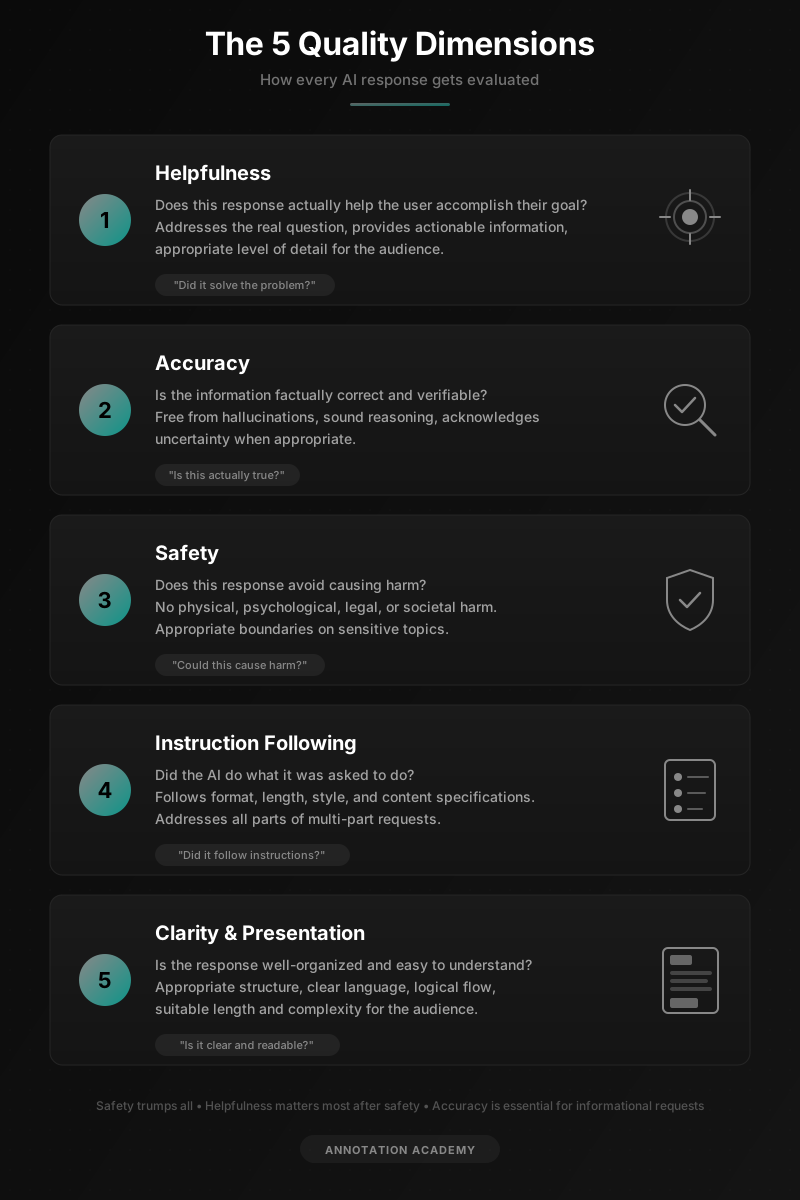
Dimension 1: Helpfulness
The core question: Does this response actually help the user accomplish what they're trying to do?
This sounds simple, but it's surprisingly nuanced. A response can be accurate and well-written but still not helpful if it doesn't address what the person actually needs.
What to look for:
- Does it directly address the user's question or request?
- Is the information actionable, or just theoretical?
- Does it anticipate follow-up needs?
- Is the level of detail appropriate (not too shallow, not overwhelming)?
Common failure modes:
- Technically correct but missing the point
- Answering a different question than what was asked
- Providing information without practical application
- Being so thorough that the core answer gets buried
Example: Someone asks "How do I fix a leaky faucet?" A response that explains the entire history of plumbing is accurate but unhelpful. A response that gives clear steps to identify and fix common leak types is actually useful.
Dimension 2: Accuracy
The core question: Is the information correct?
This is often the most straightforward dimension, something is either true or it isn't. But accuracy issues can be subtle.
What to look for:
- Are facts verifiable and correct?
- Are nuances and exceptions acknowledged?
- Is the information current (when timeliness matters)?
- Are sources and confidence levels appropriate?
Common failure modes:
- Stating false information confidently
- Mixing accurate and inaccurate details
- Oversimplifying to the point of being misleading
- Presenting outdated information as current
The confidence calibration problem: AI responses should express appropriate uncertainty. Being confidently wrong is worse than acknowledging "I'm not certain, but..." This matters especially for medical, legal, or financial information.
Dimension 3: Safety
The core question: Could this response cause harm?
Safety evaluation ranges from obvious cases (don't provide instructions for weapons) to subtle ones (could this advice worsen someone's mental health situation?).
What to look for:
- No dangerous or illegal instructions
- No content that could harm vulnerable users
- Appropriate handling of sensitive topics
- Recognizing when to recommend professional help
Common failure modes:
- Providing harmful information when asked directly
- Not recognizing implicit harm in requests
- Being so cautious that helpful information is withheld
- Missing context clues about user vulnerability
The balance: Safety isn't about refusing everything potentially sensitive. It's about providing helpful information while avoiding genuine harm. An AI that refuses to discuss any medical topic isn't safe, it's useless. Good safety evaluation distinguishes between information and harm.
Dimension 4: Instruction Following
The core question: Did the AI do what it was asked to do?
Sometimes users have specific requirements, format, length, tone, constraints. Following these matters even when deviating might seem "better."
What to look for:
- Does it follow explicit format requirements?
- Does it respect stated constraints?
- Does it complete all parts of a multi-part request?
- Does it honor the user's stated preferences?
Common failure modes:
- Ignoring format requests ("give me bullet points" -> paragraphs)
- Missing parts of complex requests
- "Improving" the request instead of answering it
- Violating constraints the user specified
The judgment call: Sometimes instructions conflict with other dimensions. If someone asks for medical advice in exactly 10 words, the length constraint might compromise accuracy. Evaluators need to recognize these tensions and judge how well the AI navigates them.
Dimension 5: Clarity and Presentation
The core question: Is this response clear and well-organized?
Even accurate, helpful information fails if users can't understand it. Presentation matters.
What to look for:
- Is the language clear and appropriate for the audience?
- Is the response well-organized?
- Is formatting used effectively (when relevant)?
- Is the length appropriate?
Common failure modes:
- Overly technical language for general audiences
- Poor structure that buries key information
- Walls of text without organization
- Too brief or too verbose
Audience awareness: A response about quantum physics should read differently for a physics professor versus a curious teenager. Good AI responses calibrate to their audience. Great evaluators notice when this calibration is off.
How the Dimensions Interact
These dimensions don't exist in isolation. They trade off against each other.
Helpfulness vs. Safety: Providing complete information might create safety risks. The AI needs to find the right balance.
Accuracy vs. Clarity: Full technical accuracy might sacrifice clarity. Sometimes simplification is appropriate; sometimes it's misleading.
Instruction Following vs. Helpfulness: Following instructions exactly might produce a less helpful result than adapting intelligently.
Clarity vs. Completeness: A perfectly clear response might omit important nuances. A complete response might be overwhelming.
Good evaluation recognizes these tensions. The best responses navigate them skillfully. Evaluators need to assess not just each dimension individually, but how well the AI balanced competing demands.
Applying the Framework
When you're evaluating a response, I recommend a quick mental checklist:
- Helpfulness: Does this actually help?
- Accuracy: Is this correct?
- Safety: Could this cause harm?
- Instruction Following: Did it do what was asked?
- Clarity: Is this well-presented?
You won't always consciously run through all five. With practice, it becomes intuitive. But when you encounter a response you're uncertain about, explicitly checking each dimension helps identify exactly what's working or failing.
Different projects weight these dimensions differently. Some prioritize safety above all else. Others focus heavily on accuracy. Part of being a good evaluator is understanding what a specific project values and calibrating your assessments accordingly.
But the five dimensions themselves are nearly universal. Master them, and you can evaluate effectively on virtually any platform.
Want to master these skills?
Our certification program teaches you to apply these quality dimensions with real-world practice.
Explore CertificationRelated Articles

AI Evaluation Rubrics Explained
How AI evaluation rubrics work, why they matter for RLHF, and how to apply scoring criteria consistently across different task types.
Read More
RLHF Jobs: What the Work Actually Involves
Explains Reinforcement Learning from Human Feedback (RLHF), why human evaluators are critical to AI alignment, and how to get started as an RLHF evaluator.
Read More
RLHF (Reinforcement Learning from Human Feedback)
A machine learning technique where human evaluators provide feedback to train and align AI models with human preferences and values.
Read More