RLHF Explained: The Simple Guide to How AI Actually Learns from Humans
You've probably heard that ChatGPT was trained on "human feedback." But what does that actually mean? How do you train a computer program using human opinions?
The process is called Reinforcement Learning from Human Feedback, RLHF for short. It's the reason AI assistants went from producing random, sometimes bizarre text to actually being helpful.
Here's how it works, explained without the technical jargon.
The Problem RLHF Solves
Before RLHF, AI models had a fundamental limitation: they were trained to predict the next word in a sequence, not to be helpful.
Think about what that means. If you train a model on the entire internet, it learns to produce text that looks like internet text. That includes helpful explanations, sure. But it also includes arguments, misinformation, toxic comments, and everything else humans write online.
The model has no way to know which of these you want. Ask it a question, and it might give you a thoughtful answer. Or it might argue with you. Or produce something offensive. From the model's perspective, all of these are valid "internet-like" responses.
RLHF gives the model something it desperately needed: a way to understand what humans actually want.
Step 1: Supervised Fine-Tuning
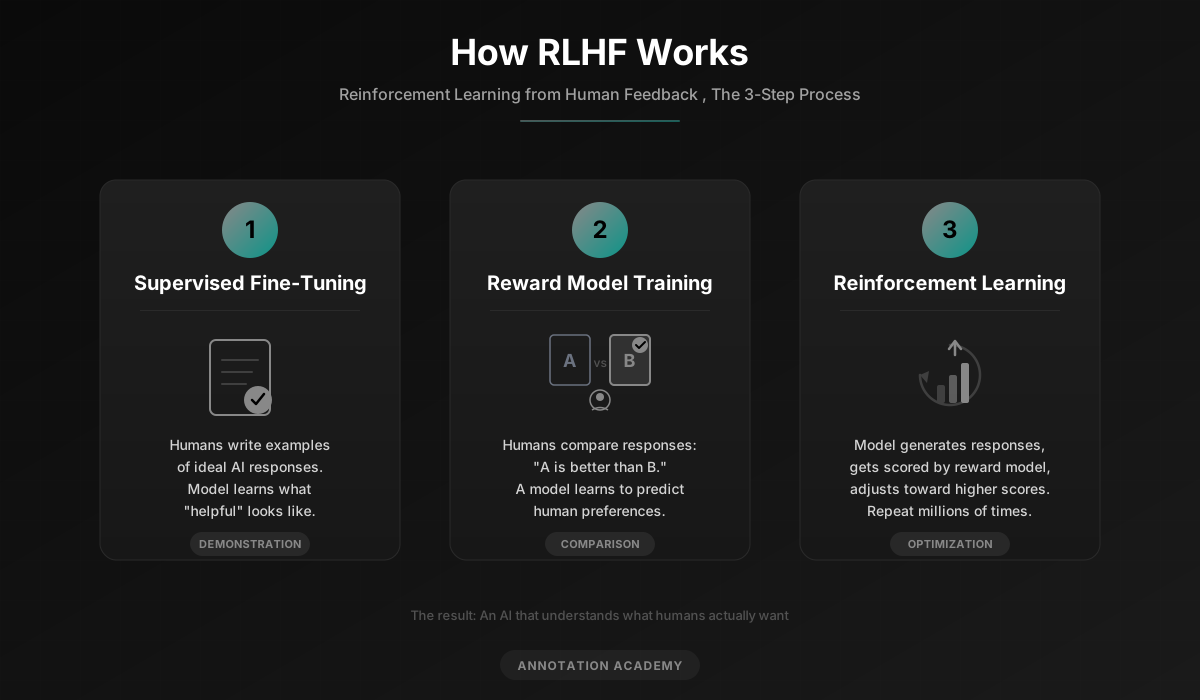
Before the human feedback part, companies start with supervised fine-tuning. This is simpler than it sounds.
Humans write examples of good AI responses. "When asked about the weather, respond like this." "When someone needs coding help, explain it like this." Thousands of these examples teach the base model what helpful responses look like.
Think of it as showing someone examples before asking them to do a task. You're not explaining every rule, you're demonstrating what good looks like.
This step gets the model in the ballpark. It starts producing responses that look more like helpful assistant text and less like random internet content. But it's still not great at knowing which responses are better than others.
Step 2: Training the Reward Model
Here's where human feedback enters the picture.
The AI generates multiple responses to the same prompt. Human evaluators look at these responses and rank them. "This one is best. This one is second. This one is worst."
These rankings are used to train a separate model called a reward model. Its job is to predict how humans would rate any given response.
Why not just have humans rate every response directly? Scale. There's no way to have humans evaluate every possible output from a model that can produce billions of different responses. The reward model acts as a stand-in for human judgment.
This is the critical piece. The reward model learns to approximate what humans find helpful, accurate, and safe. It becomes an automated way to score responses based on human preferences.
Step 3: Reinforcement Learning
Now comes the actual reinforcement learning.
The AI generates a response. The reward model scores it. If the score is high, the AI learns to produce more responses like that one. If the score is low, it learns to avoid that type of response.
This happens millions of times. The model gradually shifts toward producing responses that score well according to the reward model, which, remember, was trained on human preferences.
It's like training a dog, but instead of treats, the AI gets a mathematical reward signal. Responses that would make humans happy get reinforced. Responses that wouldn't get discouraged.
Why This Works (And Why It's Hard)
RLHF works because it aligns the model's optimization target with human preferences. Instead of optimizing for "produce text that looks like internet text," the model optimizes for "produce text that humans rate highly."
But it's harder than it sounds.
Getting consistent human feedback is expensive. You need thousands of hours of human evaluation. The evaluators need to be trained. Their ratings need to be consistent enough to train a useful reward model.
Reward models aren't perfect. They approximate human judgment, but they can be wrong. If the reward model has blind spots, the AI will learn to exploit them, producing responses that score well but aren't actually good.
Different humans want different things. Should the AI be formal or casual? Detailed or concise? Different evaluators have different preferences, and the model has to learn some average of these preferences.
Gaming the reward. Models can sometimes learn to produce responses that trick the reward model into giving high scores without actually being helpful. This is called reward hacking, and it's an ongoing challenge.
The Role of AI Evaluators
This is where AI evaluators come in. The entire RLHF process depends on quality human feedback.
Evaluators do the comparison rankings that train the reward model. They identify cases where the reward model is wrong. They catch new problems that emerge as the model changes. They provide the ground truth that the entire system is built on.
Without skilled evaluators providing consistent, thoughtful feedback, RLHF doesn't work. The reward model would be trained on noisy, inconsistent data, and the final AI would reflect that noise.
This is why AI companies pay significant rates for quality evaluation work. The feedback directly determines how well the AI performs.
What RLHF Can and Can't Do
RLHF is powerful, but it has limits.
It can: Make models more helpful, reduce harmful outputs, align behavior with human preferences, make AI feel more natural to interact with.
It can't: Give the model new knowledge, fix fundamental capability limits, guarantee safety, or solve problems that humans themselves disagree about.
If humans can't agree on what a good response looks like, RLHF can't magically find the right answer. It optimizes for human preferences, but only to the extent that humans can articulate and agree on those preferences.
The Bigger Picture
RLHF represents a fundamental shift in how AI is trained. Instead of just learning from data, models now learn from human judgment about what's good and what isn't.
This is why the current generation of AI assistants feels so different from earlier attempts. They're not just predicting text, they're optimizing for human satisfaction.
And every time you interact with an AI and it produces a helpful response, there's a chain of human evaluators whose feedback made that possible. They compared responses, made judgments, provided rankings, and those rankings became the signal that trained the model.
It's a strange collaboration between humans and machines. We teach them what we want, and they learn to provide it. The better we get at expressing our preferences, the better they get at meeting them.
Want to learn more?
Our certification program teaches you the exact evaluation skills that power RLHF at top AI companies.
Explore Annotation AcademyRelated Articles

What Is RLHF and Why Do AI Companies Need Human Evaluators?
Explains Reinforcement Learning from Human Feedback (RLHF), why human evaluators are critical to AI alignment, and how to get started as an RLHF evaluator.
Read More
AI Evaluation Rubrics Explained
How AI evaluation rubrics work, why they matter for RLHF, and how to apply scoring criteria consistently across different task types.
Read More
The 5 Quality Dimensions: How to Evaluate Any AI Response Like a Pro
Master the 5 key quality dimensions used by professional AI evaluators.
Read More